
← All journal entries
Travel Advice 7 min read

Wild Great Wall: Jinshanling vs Jiankou vs Mutianyu vs Badaling

Four Great Wall sections near Beijing, compared honestly — which is crowded, which is risky, and why the wild wall we build walks around is Jinshanling.

The most photographed stretch of wild Great Wall near Beijing — Jiankou, its towers split open to the sky on white limestone crags — is also the riskiest to walk. It’s a much harder climb than the other three, with a real risk of falls and of old, crumbling brick giving way, and access has been restricted in 2026 after recent public safety incidents.

Most Great Wall guides skip that part. They also skip the good news: the wild wall worth walking — ticket gate, specialist guide, a farm-stay at the bottom — is Jinshanling, about two hours north-east of the city.

So here’s the honest comparison of the four sections people ask us about — Badaling, Mutianyu, Jiankou and Jinshanling — and how we build a wild-wall walk into a longer private trip.

When to go: September and October are the standout months — clear skies, dry air, autumn colour on the ridges. Late April and May are the other good run, after the spring dust and before the summer heat. Winter is cold and stark, with thinner crowds.

SectionThe wallCrowdsFrom central BeijingBest for
Badaling 八达岭Heavily restoredCapped at 65,000 visitors a dayIts own high-speed rail stationA quick look
Mutianyu 慕田峪Fully restored, forested ridgeQuieter than Badaling~1.5 hours by roadFamilies and mixed ages
Jiankou 箭扣Unrestored, crumbling, cliff-edgeAccess restricted in 2026Next to Mutianyu, Huairou DistrictPhotographs — too risky to walk
Jinshanling 金山岭Restored at the west end, wild to the eastFar fewer people~2 hours by roadWalkers, over several days

Badaling — built for volume (八达岭)

Badaling is the Great Wall at its most organised. In 2019 it introduced real-name online booking and a cap of 65,000 visitors a day, and the same year the Beijing–Zhangjiakou high-speed railway gave it its own station — Badaling Great Wall, 102 metres underground, the deepest high-speed rail station in the world. The wall itself is heavily restored, easy to reach and very rarely quiet.

Our view: go if you want the box ticked and the clock is tight. If you want to walk the wall rather than queue on it, give the day to Mutianyu or Jinshanling.

Mutianyu — the right restored wall (慕田峪)

If you want one easy, beautiful day on the wall, it’s Mutianyu. It’s about an hour and a half north-east of the city, fully restored along a forested ridge, and quieter than Badaling. A cable car lifts you to Tower 14, and from there the walk climbs the ridge towards Tower 23. Coming down, a chairlift and a toboggan run from Tower 6 — the toboggan being the bit children talk about afterwards.

It’s the section we give a full day to on our Classic China tour, and the one we’d pick for any mixed-age group. There’s more on how we run the day in our Beijing guide.
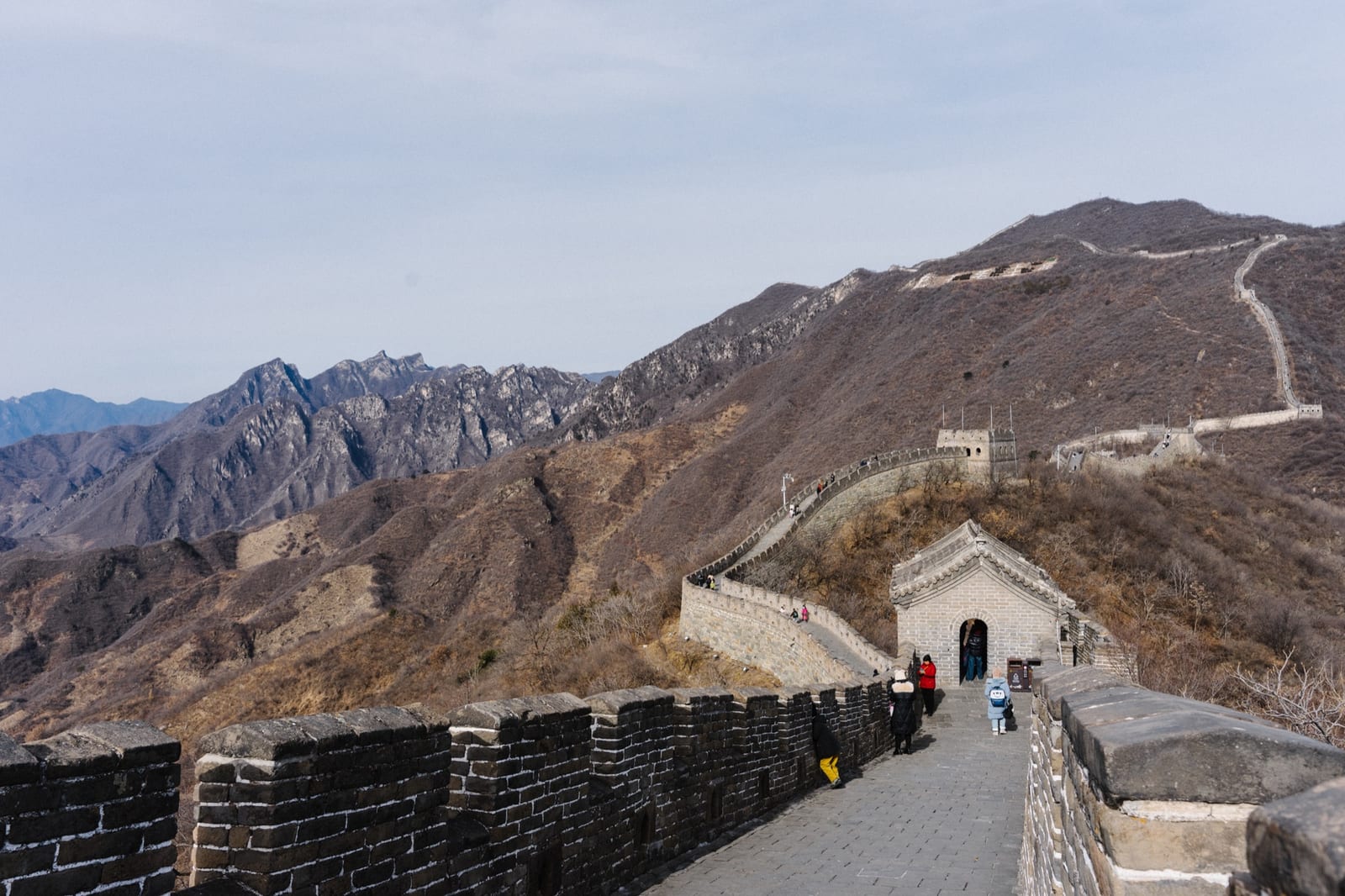
Restored ramparts at Mutianyu in winter — visitors on the wide paved walkway, the wall climbing the bare ridge to watchtowers above

Jiankou — spectacular, and genuinely risky (箭扣)

Beyond Mutianyu’s Tower 23, the wall runs on unrestored into Jiankou. The name means “arrow nock” — the notch at the end of an arrow — after the shape of the ridge. This is the wall of the famous photographs: watchtowers split open to the sky, ramparts clinging to white limestone crags, named stretches like the Sky Ladder and the Beijing Knot.

It’s also a much harder climb than anything else on this list — steep, exposed pitches like the Sky Ladder, with a real risk of falls and of old, crumbling brick giving way underfoot. After recent public safety incidents, access to Jiankou has been restricted in 2026, and we don’t take anyone onto it.

That’s less of a loss than it sounds. When someone asks us for Jiankou, we build them Jinshanling.
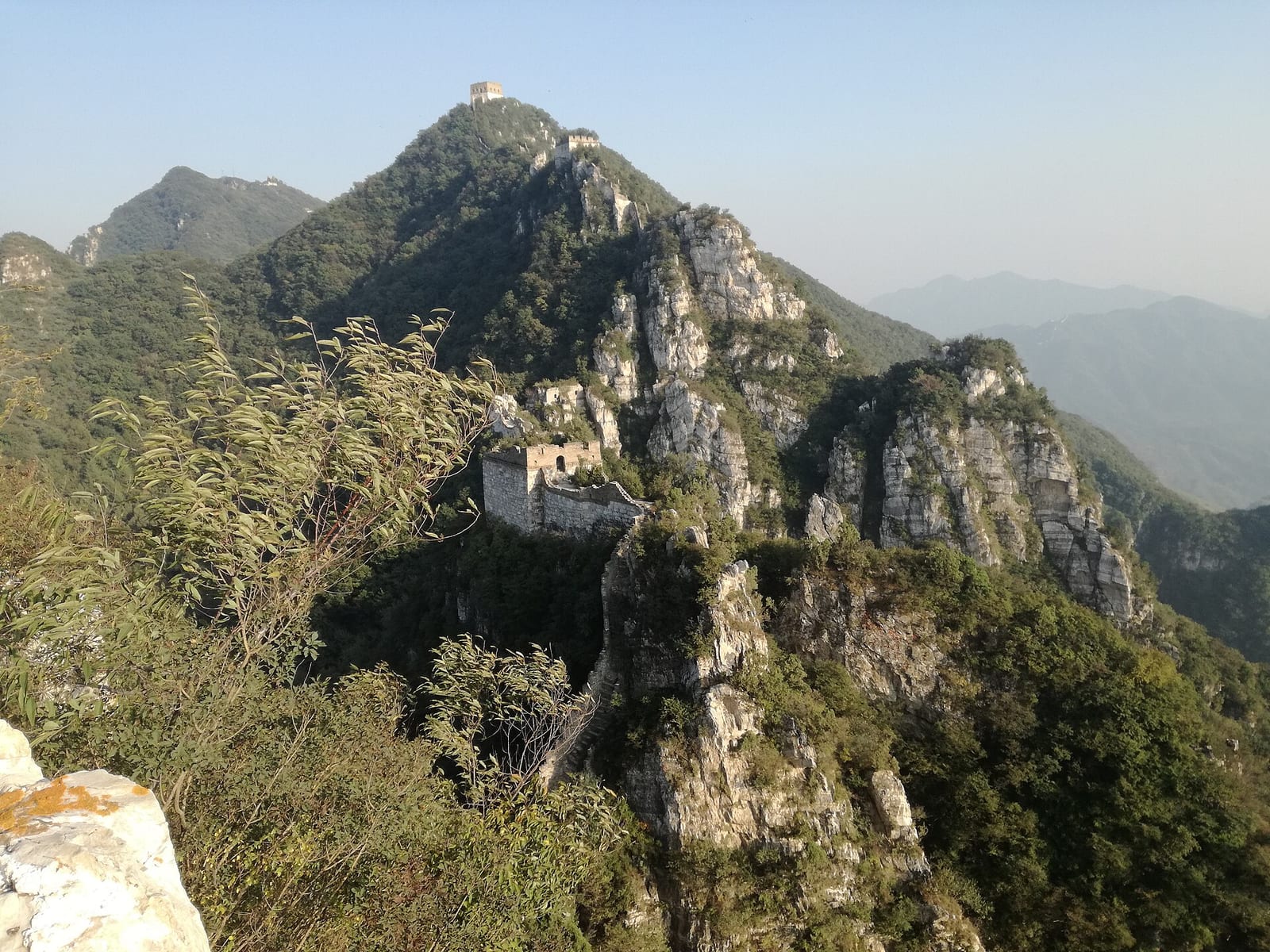
A ruined watchtower and crumbling wall clinging to white limestone crags at Jiankou, towers on the summit above — spectacular, and a genuinely risky climb

Jinshanling — the wild Great Wall you can actually walk (金山岭)

Jinshanling sits about two hours north-east of Beijing, just over the line into Hebei, and it’s one of the finest surviving stretches of Ming engineering anywhere on the Great Wall. It’s restored near its western end and grows wilder and emptier the further east you go — the chain of watchtowers marching over the ridges ahead, original Ming brick underfoot.

And every section we walk here — Gubeikou, Jinshanling, Simatai — is opened and ticketed. The wild wall, with a ticket gate and a guide.

How we walk it: three days, village to village

We don’t do Jinshanling as a day trip. We walk it as a relay — Gubeikou, then Jinshanling, then Simatai — and each morning you step back onto the wall exactly where you came off it the day before.

Day 1 — Gubeikou. Your guide and driver collect you from your Beijing hotel after breakfast, and it’s about two hours to Gubeikou, an old garrison town where the wall has guarded the pass for centuries. Straight up onto the Panlongshan ridge and east along original Ming brick: collapsed towers open to the sky, and almost nobody else up there. You come off at the old pass where Gubeikou hands over to Jinshanling, and it’s a short drive to your base for the next three nights — a family-run farm-stay in Hualougou village, right below Jinshanling’s ticket gate. Simple twin rooms, home cooking, dinner and breakfast in, and the wall on the skyline above the courtyard.
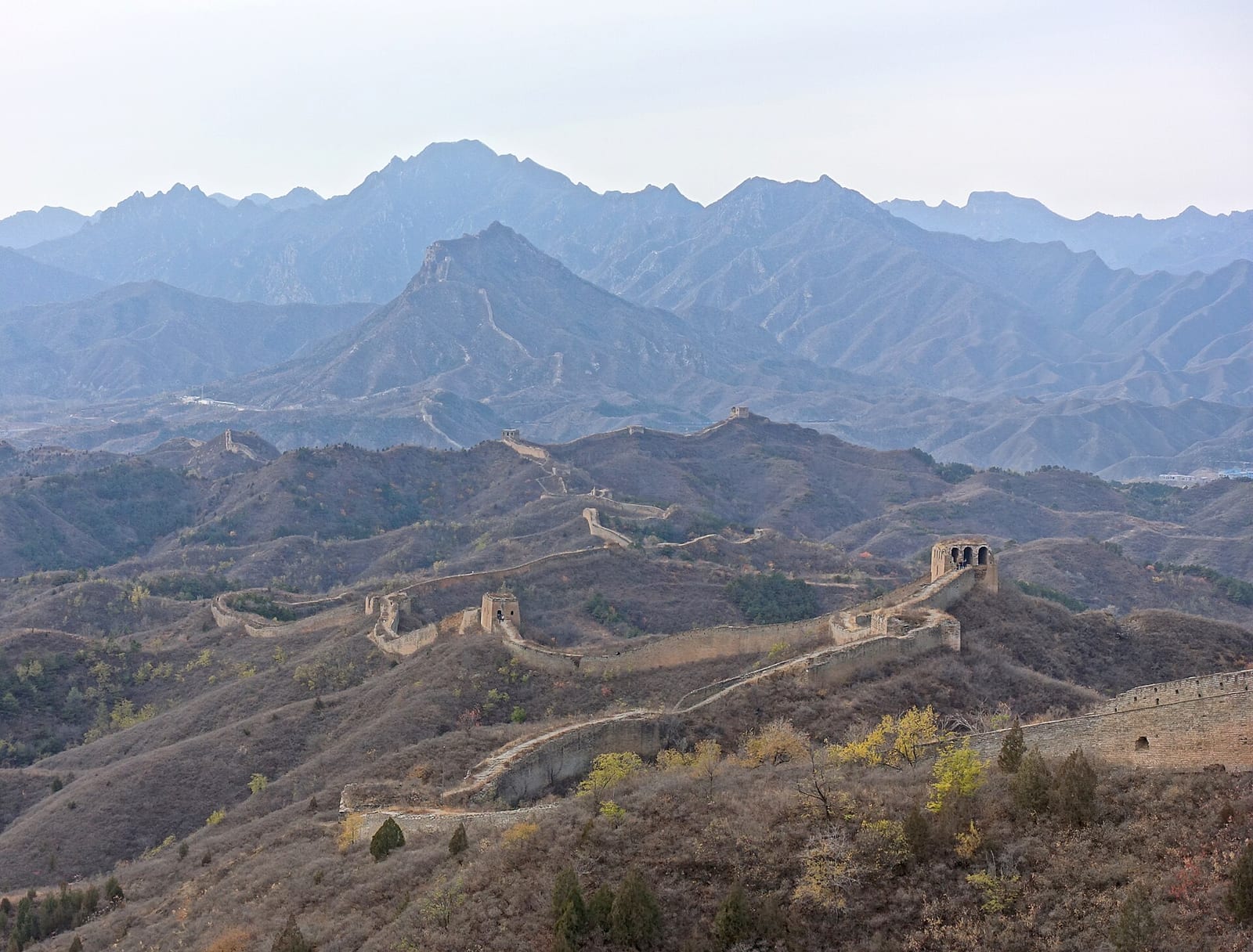
Unrestored Great Wall at Gubeikou winding over bare autumn ridges past ruined watchtowers, big mountains behind — day one of the wild-wall walk to Jinshanling

Day 2 — the full Jinshanling chain. The longest day: six to seven hours walking the whole of Jinshanling west to east, watchtower to watchtower. You’re down at the east gate by late afternoon and back at the farm-stay for dinner and an early night.
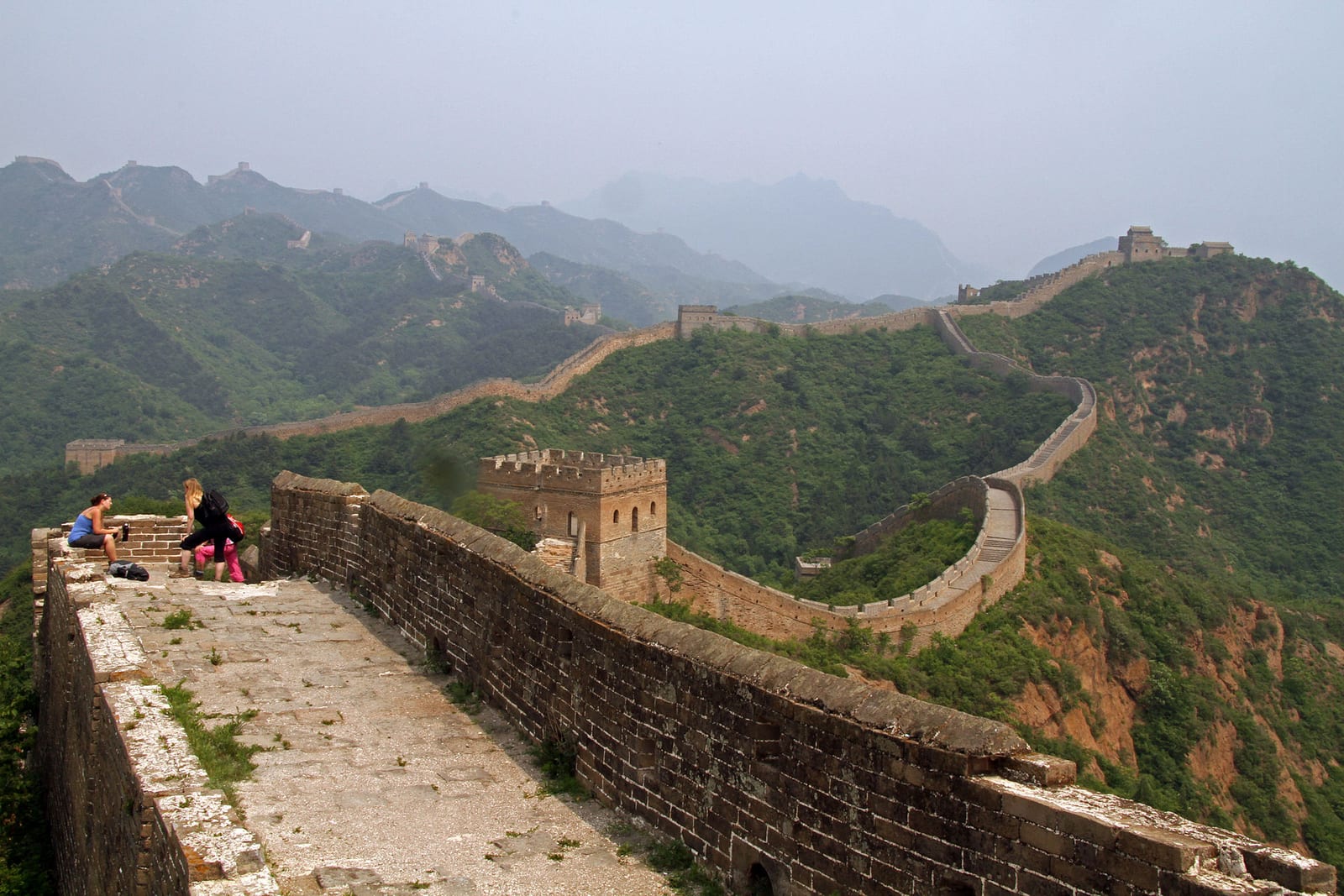
Walkers resting on top of the Great Wall on the way from Gubeikou to Jinshanling, the wall curving away over green summer ridges to distant watchtowers

Day 3 — Simatai. Reached through the Gubei Water Town complex, Simatai is steep and narrow — the ridge climbing tower by tower toward the crags, the whole Gubeikou valley opening out below. It also opens for evening walks year-round, with the Water Town’s lantern-lit canals below.
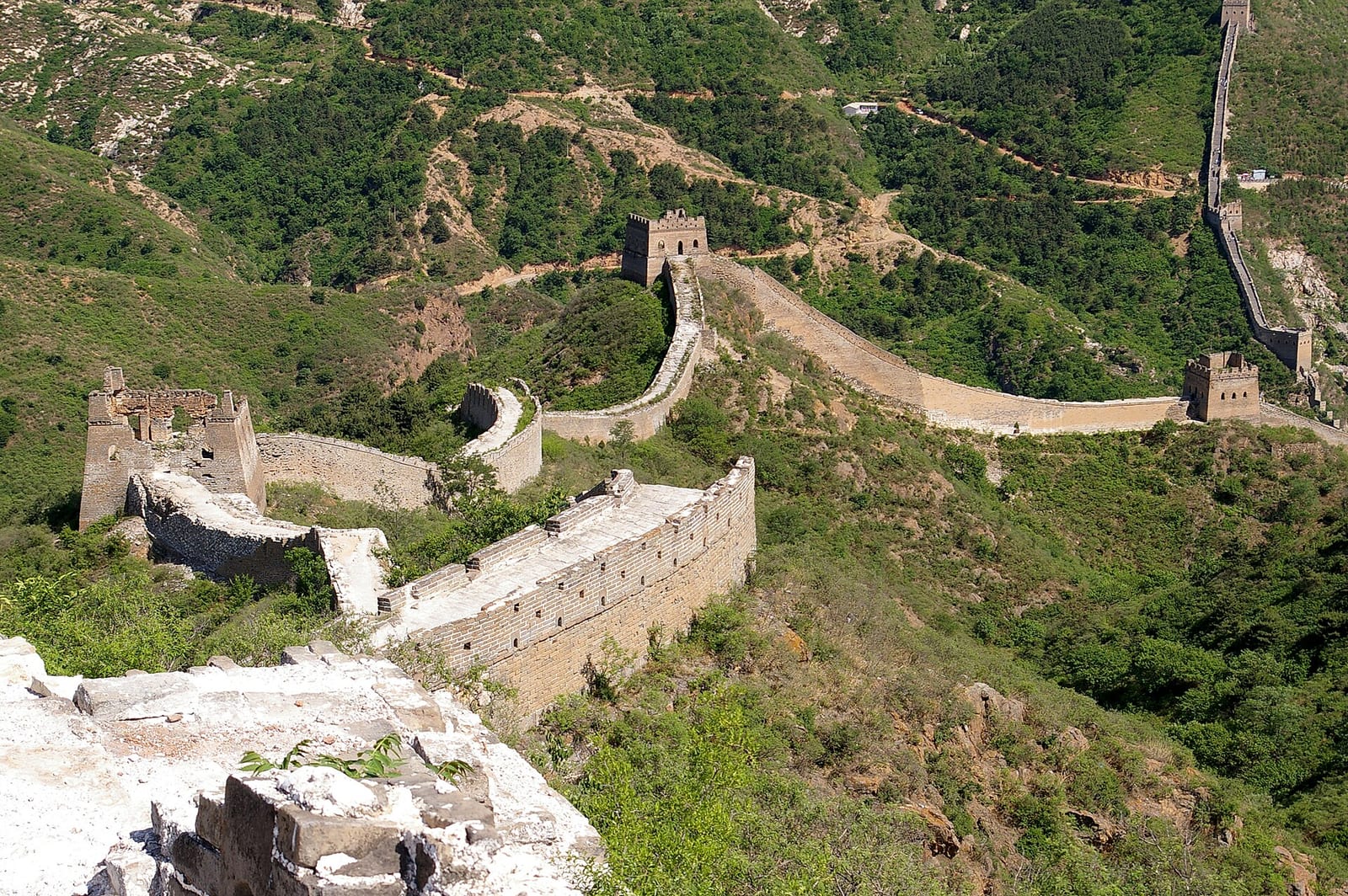
The Great Wall at Simatai winding through green scrub past a half-ruined watchtower, the ridge climbing steeply beyond

Day 4 is a slow farm-stay breakfast and the two-hour drive back into the city.

How hard is it? It’s original Ming brick — steep, broken in places, big uneven steps. If you walk regularly and don’t mind stairs, you’ll enjoy it. If knees are the question, Mutianyu is the answer.

Where the wall fits in a longer trip

The relay takes four days of a trip — three on the wall and a slow morning back — and it sits naturally at the start or end of a Beijing stay. One trip we’ve built this year runs thirteen days: three days walking from Gubeikou to Simatai, then Xi’an and the Terracotta Army, a night on Huashan’s summit, and three big walking days through Zhangjiajie’s stone-pillar country.

Two of our Classic China journeys build the wall in too: Warriors, Pandas & Stone Pillars spends a day on Jinshanling before Xi’an, the pandas and Zhangjiajie, and Classic China & Yunnan walks Mutianyu before flying south to Yunnan’s old towns.

Back in the city, Mandarin Oriental Wangfujing puts you a short walk from the Forbidden City — a good base for the palace days either side of the wall.

Before you go

  • Tickets. Badaling’s tickets are real-name and booked online in advance. On our wild-wall walks, every entry — Gubeikou, Jinshanling and Simatai — is arranged for you.
  • A guide who knows the route. The relay between sections takes local knowledge, so we walk it with a specialist wall guide. Here’s what a private guide actually does.
  • Getting there. Check China’s visa-free entry rules, and set up your China travel apps before you fly.

So which section should you walk?

  • Walkers who want the wild wall: Jinshanling, as a three-day relay from Gubeikou to Simatai with a farm-stay under the wall. It’s the one we’d choose ourselves.
  • Families and mixed ages: Mutianyu — cable car up, toboggan down, and a restored wall everyone can manage.
  • Short on time: Badaling by high-speed train. Efficient, if not quiet.
  • Jiankou: admire it in the photographs — it’s too risky to walk, and access is restricted in 2026. The wild wall to walk is Jinshanling.

Want the wild wall done properly? Tell us your dates and we’ll build the walk into your trip.


Photos via Wikimedia Commons: Jinshanling (cover) and Gubeikou by Luka Peternel, CC BY-SA 4.0; on the wall from Gubeikou to Jinshanling by Ronnie Macdonald, CC BY 2.0; Simatai by Jakub Hałun, CC BY-SA 4.0; Jiankou by Sindarus, CC BY-SA 4.0; Mutianyu by Lloyd Tudor, CC BY-SA 4.0.

Quick answers

Common questions

01 Can you hike the Jiankou Great Wall?

Access has been restricted in 2026 after recent public safety incidents, and it's a much harder, riskier climb than the other sections near Beijing — steep, exposed and unrestored, with a real risk of falls and of old, crumbling brick giving way. For wild, original-brick wall you can walk with a guide and a ticket, go to Jinshanling.

02 Is Mutianyu or Jinshanling better?

Mutianyu for families and mixed ages: it's fully restored, about an hour and a half from Beijing, with a cable car up to Tower 14 and a toboggan back down from Tower 6. Jinshanling for walkers: about two hours from Beijing, restored near its western end and wilder the further east you go, and best walked over several days.

03 Is Badaling worth visiting?

It's efficient rather than quiet. Badaling introduced real-name online booking and a cap of 65,000 visitors a day in 2019, and the Beijing–Zhangjiakou high-speed railway stops at its own station. If you want to walk the wall rather than queue on it, choose Mutianyu or Jinshanling.

04 How hard is the Jinshanling walk?

It's original Ming brick — steep, broken in places, with big uneven steps. On our three-day relay the longest day, the full Jinshanling chain, is six to seven hours of walking. Regular walkers who don't mind stairs enjoy it; if knees are a worry, Mutianyu is the easier wall.

Keep reading

More from the journal

What a Private Guide Does in Yunnan and Sichuan
Travel Advice

What a Private Guide Does in Yunnan and Sichuan

17 April 2026 · 8 min read

A private guide in Yunnan and Sichuan solves permits, altitude, weather, and access group tours can't reach. Here's what they do — and why it pays back.

Read article →
Fuxian Lake & the Yunnan Lakes Kunming Keeps for Itself
Yunnan

Fuxian Lake & the Yunnan Lakes Kunming Keeps for Itself

9 October 2026 · 8 min read

Everyone knows Erhai and Lugu. Kunming people spend their weekends at Fuxian, Yangzonghai and four quieter lakes south of the city. Here's what each is really like.

Read article →
Kunming's Parks & Temples: 7 Places the Locals Actually Go
Yunnan

Kunming's Parks & Temples: 7 Places the Locals Actually Go

9 October 2026 · 7 min read

Most travellers treat Kunming as an airport. Give it a day and see the city locals know: gulls on Green Lake, the Dragon Gate cliffs, a bronze temple and an old fishing village at sunset.

Read article →
The Yunnan–Vietnam Railway: History & Where to Walk It
Yunnan

The Yunnan–Vietnam Railway: History & Where to Walk It

9 October 2026 · 8 min read

The French drove a metre-gauge railway from Haiphong to Kunming in 1910. The passenger trains have gone, but the tunnels, stations and bridges are still there — and you can walk the best of it.

Read article →
Lijiang Ancient Towns: Why We Prefer Shuhe & Baisha
Yunnan

Lijiang Ancient Towns: Why We Prefer Shuhe & Baisha

28 July 2026 · 6 min read

Lijiang has three ancient towns, not one. The honest difference between Dayan, Shuhe and Baisha — and why we book our travellers into the quieter two.

Read article →
Little Chinese Everywhere Tours — Built With Boutique China
News

Little Chinese Everywhere Tours — Built With Boutique China

14 July 2026 · 3 min read

We're partnering with Little Chinese Everywhere on small-group Yunnan tours. Two journeys, groups of up to 8, first departure 10 September.

Read article →
Five Days in the Pu'er Tea Mountains: Mario & His Guest
Guest Stories

Five Days in the Pu'er Tea Mountains: Mario & His Guest

10 July 2026 · 6 min read

Two European guests, five green-season days across Nannuo and Jingmai — the monsoon that couldn't stop the tea, a cake pressed by hand, and a fire-pit evening inside the UNESCO landscape. A guest story.

Read article →
Pu'er Tea in Yunnan: Where to Go and What to Taste
Yunnan

Pu'er Tea in Yunnan: Where to Go and What to Taste

8 July 2026 · 11 min read

Where Pu'er tea actually comes from — Menghai, Yiwu, UNESCO-listed Jingmai and Lincang — the five villages collectors chase, and how to taste them properly.

Read article →
Meili Snow Mountain Travel Guide: A Yunnan North Highlight
Yunnan

Meili Snow Mountain Travel Guide: A Yunnan North Highlight

6 May 2026 · 12 min read

A Meili Snow Mountain travel guide built from a recent client trip — sunrise on Kawagarbo, the Yunnan North circuit, and why we booked Poodom over Songtsam.

Read article →
When Xin & Lorraine Walked Dali to Shangri-La — Their 14 Days in Yunnan
Guest Stories

When Xin & Lorraine Walked Dali to Shangri-La — Their 14 Days in Yunnan

21 April 2026 · 11 min read

A case study in private Yunnan travel — Xin and Lorraine's April 2026 trip, day by day. Dali courtyards, Shaxi market mornings, the Tiger Leaping Gorge upper trail, Songzanlin, and three days at the foot of Meili Snow Mountain. What ran, what we changed mid-trip, and the calls they never saw.

Read article →
China Visa-Free for Australians: What We Actually Get Asked
Practical

China Visa-Free for Australians: What We Actually Get Asked

17 April 2026 · 6 min read

China's 30-day visa-free policy for Australian passports is now approaching two years old. Here's what it means, what to ignore, and what the border actually feels like.

Read article →
Shangri-La Hiking: 9 Trails Beyond Tiger Leaping Gorge
Yunnan

Shangri-La Hiking: 9 Trails Beyond Tiger Leaping Gorge

10 April 2026 · 12 min read

Tiger Leaping Gorge is only the start. Nine alpine routes across Shangri-La's high country, from day hikes to multi-day treks.

Read article →
Jiuzhaigou 2026: Crowds, Permits & Quiet Alternatives
Sichuan

Jiuzhaigou 2026: Crowds, Permits & Quiet Alternatives

7 April 2026 · 6 min read

Everything you need to know about visiting Jiuzhaigou in 2026 — daily quotas, booking windows, and the lesser-known parks most travellers miss.

Read article →
Yunnan's Ethnic Minorities: 7 Cultures You'll Actually Encounter
Culture

Yunnan's Ethnic Minorities: 7 Cultures You'll Actually Encounter

7 April 2026 · 6 min read

A grounded introduction to the Bai, Naxi, Dai, Yi, Tibetan, Hani and Miao people you'll meet on our Yunnan tours.

Read article →
West Sichuan Travel Guide: Beyond Jiuzhaigou
Sichuan

West Sichuan Travel Guide: Beyond Jiuzhaigou

2 April 2026 · 9 min read

The real West Sichuan is the sky road west of the park: Tibetan monasteries, alpine lakes, and villages where tourism barely touches the edges.

Read article →
Best Boutique Hotels in Dali, Yunnan (2026)
Stays

Best Boutique Hotels in Dali, Yunnan (2026)

29 March 2026 · 6 min read

Our favourite boutique stays in Dali for 2026 — from lakeside courtyards on Erhai to restored Bai mansions in the old town.

Read article →
Essential Apps for Travelling in China (2026 Guide)
Practical

Essential Apps for Travelling in China (2026 Guide)

25 March 2026 · 3 min read

The 2026 China app kit — payments, maps, translation, what replaced Uber, and the tricks to make it all work on a foreign phone.

Read article →
Yunnan Travel Guide: Six Regions Explained
Yunnan

Yunnan Travel Guide: Six Regions Explained

23 March 2026 · 9 min read

A complete orientation to Yunnan for first-time travellers — what each region is famous for, how long to spend, and when to go.

Read article →