
Ask anyone who’s flown into Kunming which Yunnan lake they’ve heard of, and you’ll get two answers: Erhai, under Dali’s Cangshan, and Lugu, up on the Sichuan border. Ask a Kunming family where they spend a long weekend, and you’ll hear something else entirely: Fuxian. Or Yangzonghai, if they only have the Sunday.
Yunnan counts nine great plateau lakes (九大高原湖泊). Visitors know three of them. The rest sit south and east of the capital, ringed by tobacco fields, fishing villages and some of the province’s best lunches. Here are the Yunnan highland lakes that Kunming keeps for itself: which are clear and deep, which are green and shallow but worth it for the towns on their shores, and which one we’d spend a night on.
When to go: all of these lakes sit between about 1,400 and 1,900 metres, so they share Kunming’s mild climate. The dry season, roughly November to April, brings the clearest skies and the black-headed gulls that winter on the lakes. Summer is the rainy season: greener, softer light, and the lotus on Yilong Lake.
| Lake | Where | The feel | Best for |
|---|---|---|---|
| Fuxian 抚仙湖 | Yuxi | Deep, clear, blue — Yunnan’s deepest | A night by the water |
| Yangzonghai 阳宗海 | Kunming’s edge | Hot springs, golf, the old railway | A day out from Kunming |
| Xingyun 星云湖 | Jiangchuan | Shallow, green, bronze-age tombs | History, the fish legend |
| Qilu 杞麓湖 | Tonghai | Farm country and a Mongol township | Culture, small towns |
| Yilong 异龙湖 | Shiping | Lotus in summer, gulls in winter | Food, lotus season |
| Changhu 长湖 | Shilin | A karst lake in pine woods | Camping, families |
Fuxian Lake — the deep one (抚仙湖)
Fuxian is why Kunming people drive south. It covers 216.6 square kilometres, smaller on the map than Dianchi, Kunming’s own lake. But it’s 158.9 metres at its deepest and averages 95.2 metres, so it holds about 13 times as much water. That depth is what keeps it clean. Fuxian was rated Class I, the top grade, in the latest official lake-by-lake figures, and on a still morning you can see five or six metres down. Nothing else this close to Kunming looks like it: true blue water over pale limestone, with the mountains standing straight out of it.
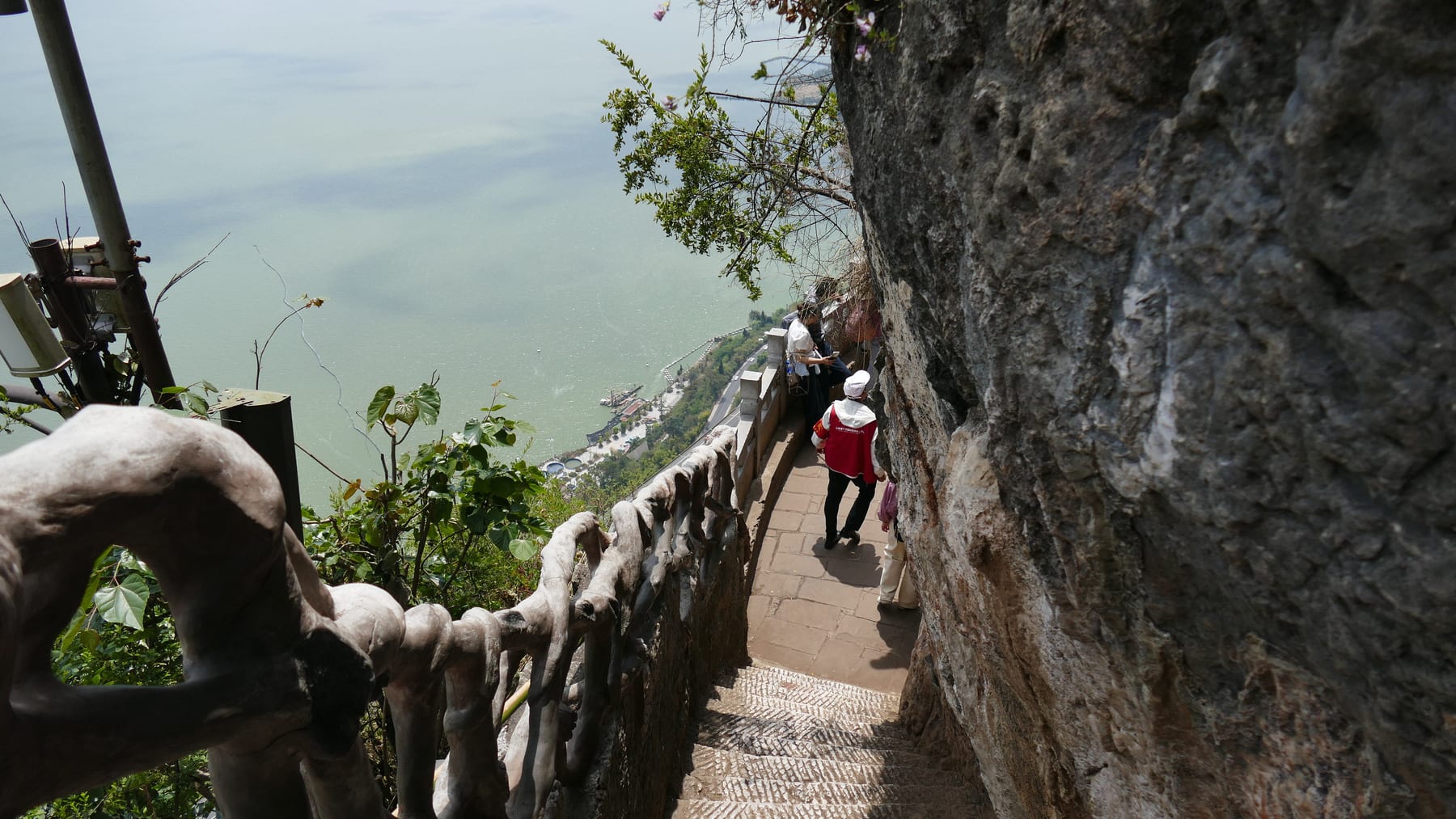
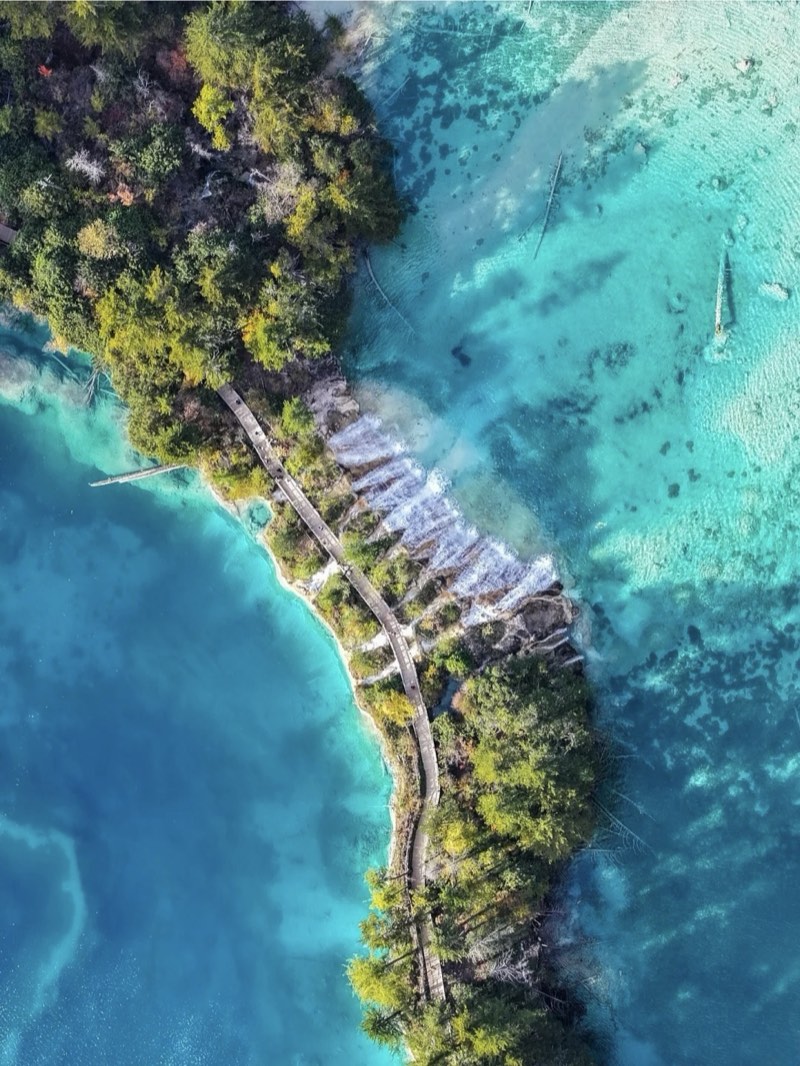
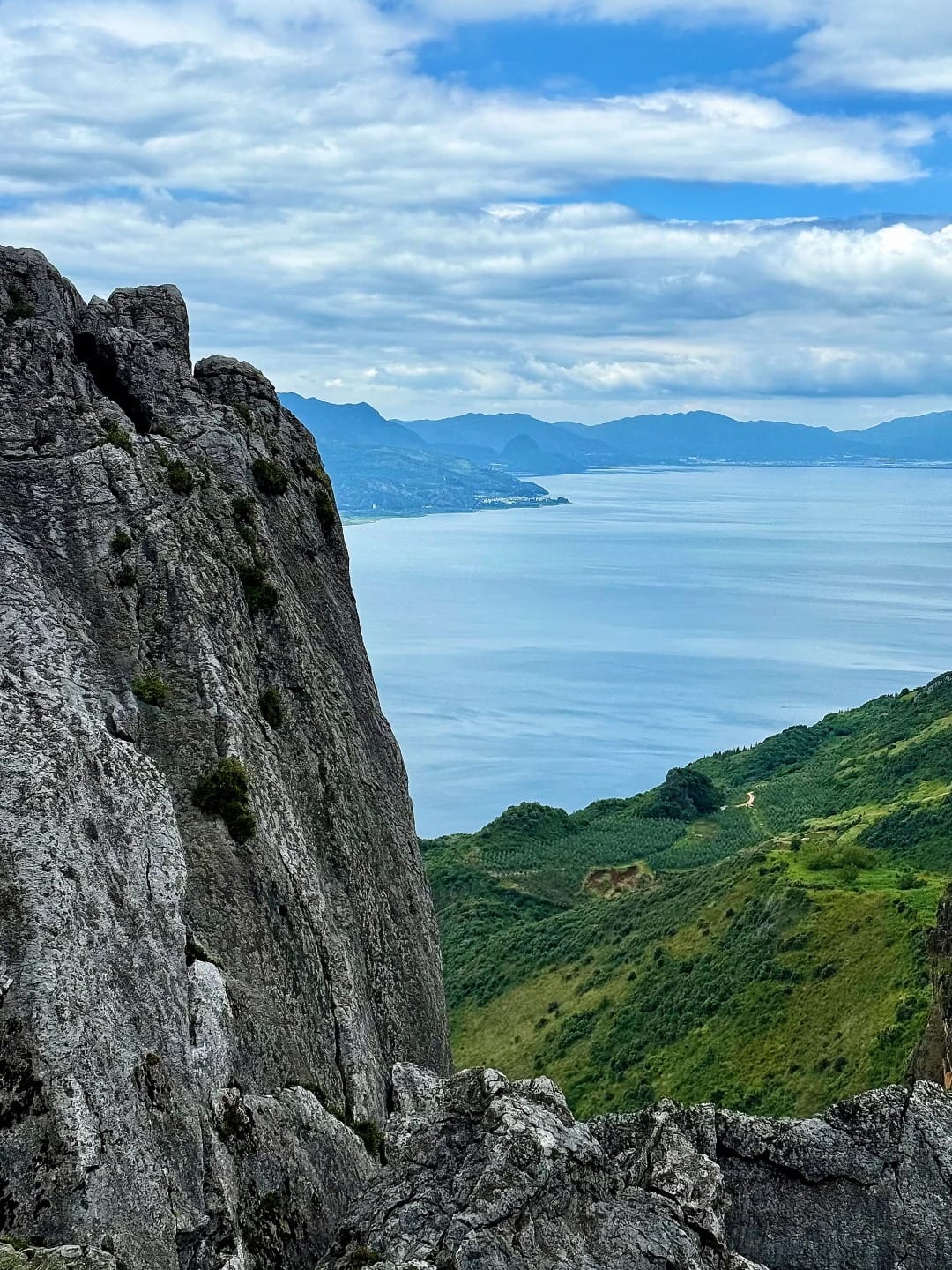
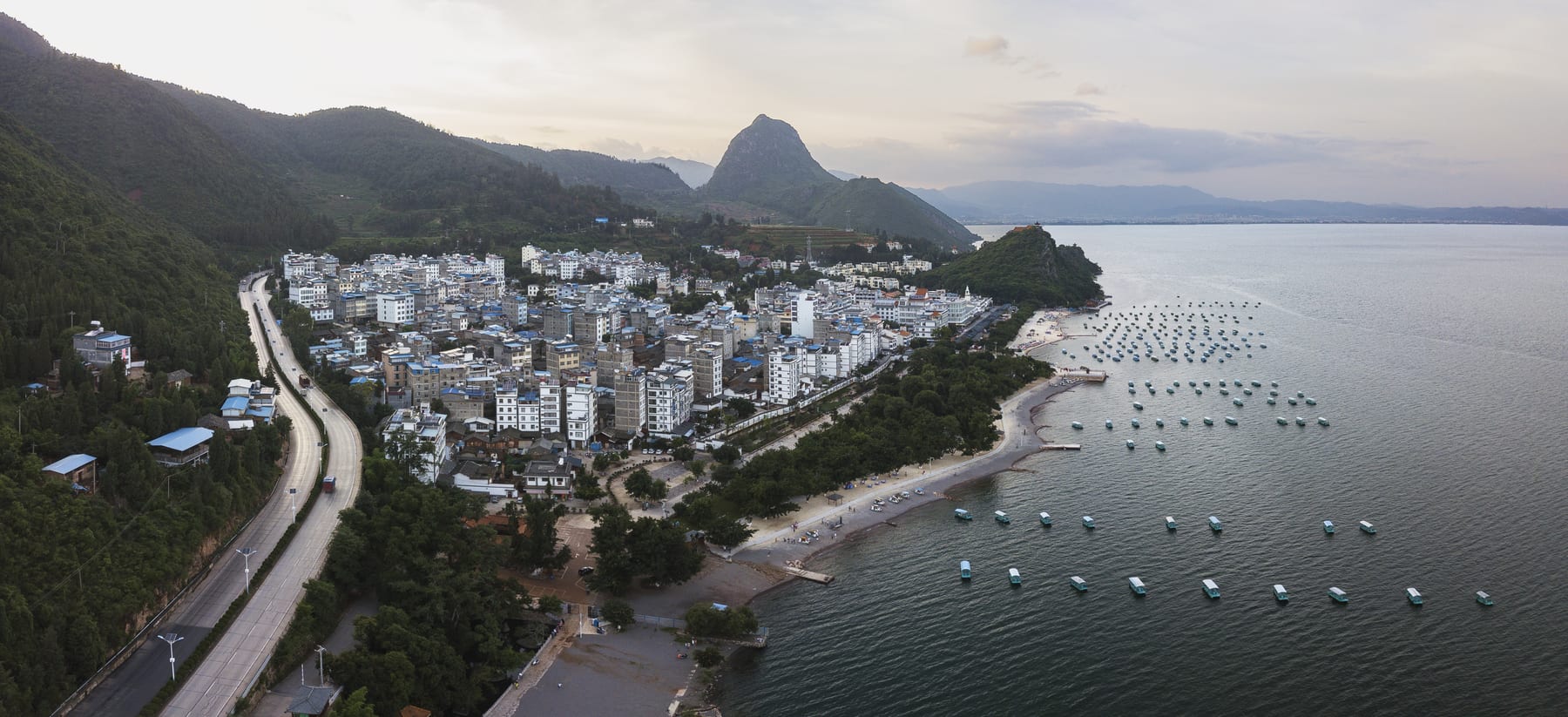
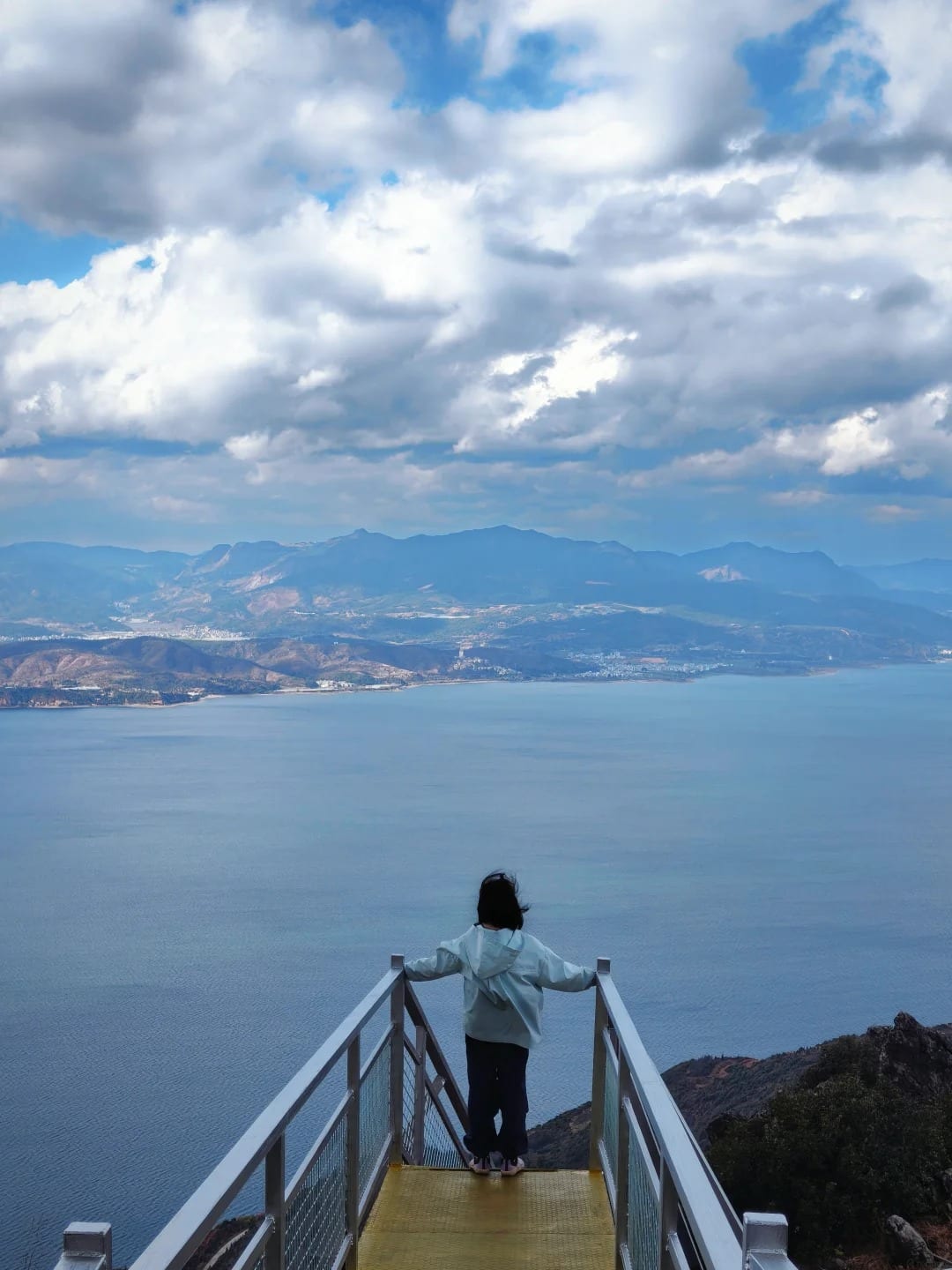
The west shore is where weekenders go. Mingxing Yudong has the sailing boats, beaches and lakeside cafés. Further south, Luchong (禄充) is an old fishing village under the Bijia Shan headland; boats from there cross to Gushan (孤山), the lake’s only island, with its temples. The east shore is quieter. That’s where we take people: the cliffs at Leidashi (雷打石), with a boardwalk and viewing platforms high above the water.
Two things most visitors never hear about. Under the north-east of the lake lie stone structures that a diver found in 1992. They were surveyed on live CCTV in 2001, and archaeologists still don’t agree what they are, or how old. And just north of the lake is the Chengjiang fossil site, UNESCO-listed in 2012, where 518-million-year-old Cambrian animals are preserved in fine detail. One of them, an early arthropod, is named Fuxianhuia after the lake.
The lake has changed a lot in the last decade. Since 2017 nearly 4,000 lakeshore households have been moved back from the water and 920,000 square metres of buildings knocked down, and the shore has gone back to wetland and lotus fields. It’s emptier than it was, and the water is better for it.
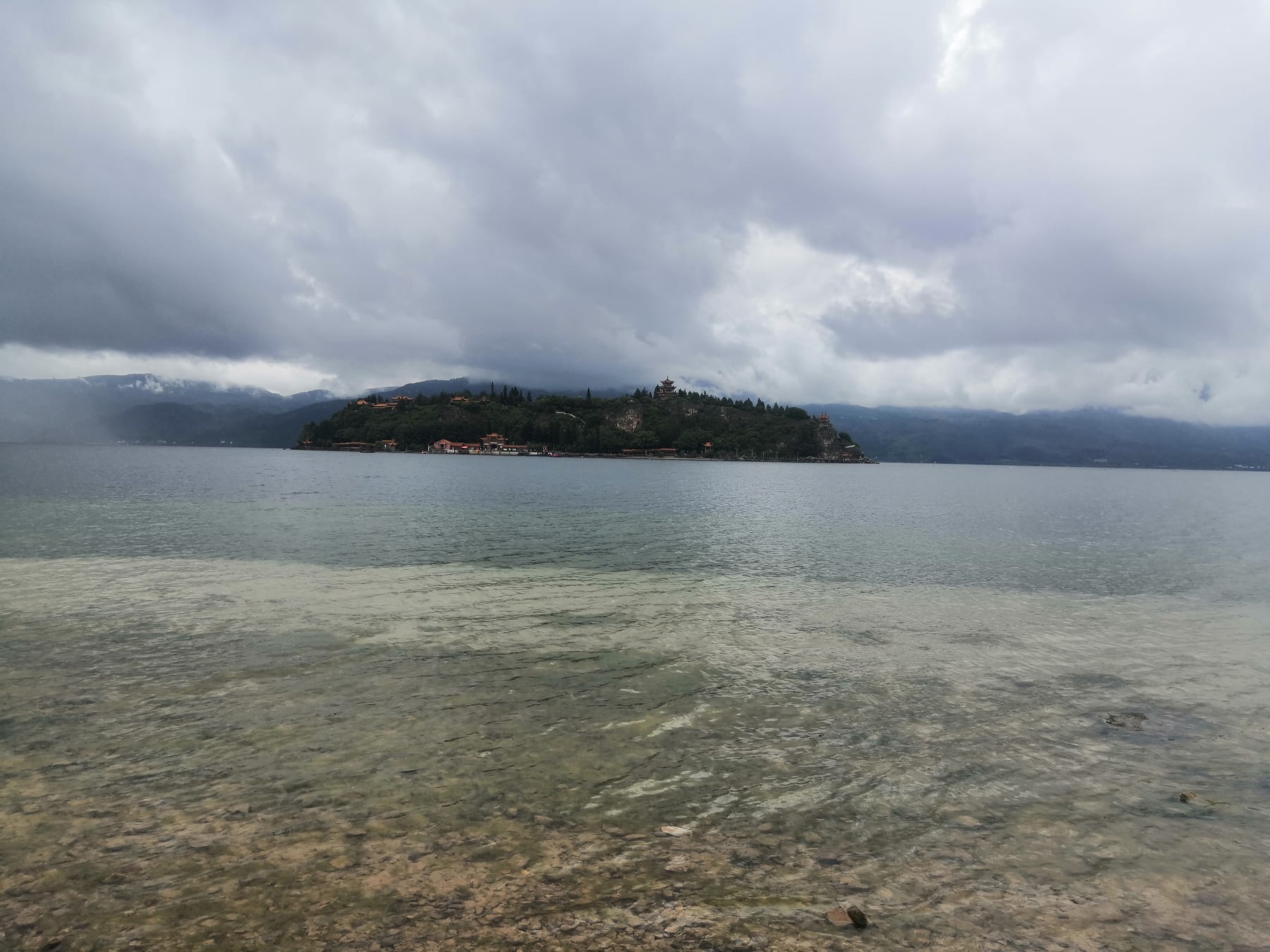
The food: the lakeshore’s dish is stone-pot fish (石锅鱼). Steam from a central boiler is piped into stone pots set into the table, so the fish cooks without a flame — broth first, then the fish, then the greens. The lake’s own fish, the endemic kanglang (抗浪鱼), is listed as Vulnerable by the IUCN. It’s been restocked since 2007 and is farmed now, which is how it reaches menus. The lake itself is closed to fishing from January to June, so most restaurant fish comes from farms nearby. Agree the price per jin (500 g) before it goes in the pot.
Yangzonghai — the one on Kunming’s doorstep (阳宗海)
Yangzonghai is about 36 kilometres from central Kunming, close enough for a Sunday. It’s a smaller lake (about 31 square kilometres, 30 metres at its deepest) at 1,770 metres. Its older name, Tangchi (汤池), means “hot pool”: hot springs rise at the north-east end, and a Ming canal was dug there in 1396 to water the Yiliang plain. Today there’s a lakeside spa resort, and Spring City Golf & Lake Resort on the shore has two courses, one by Jack Nicklaus and one by Robert Trent Jones Jr.
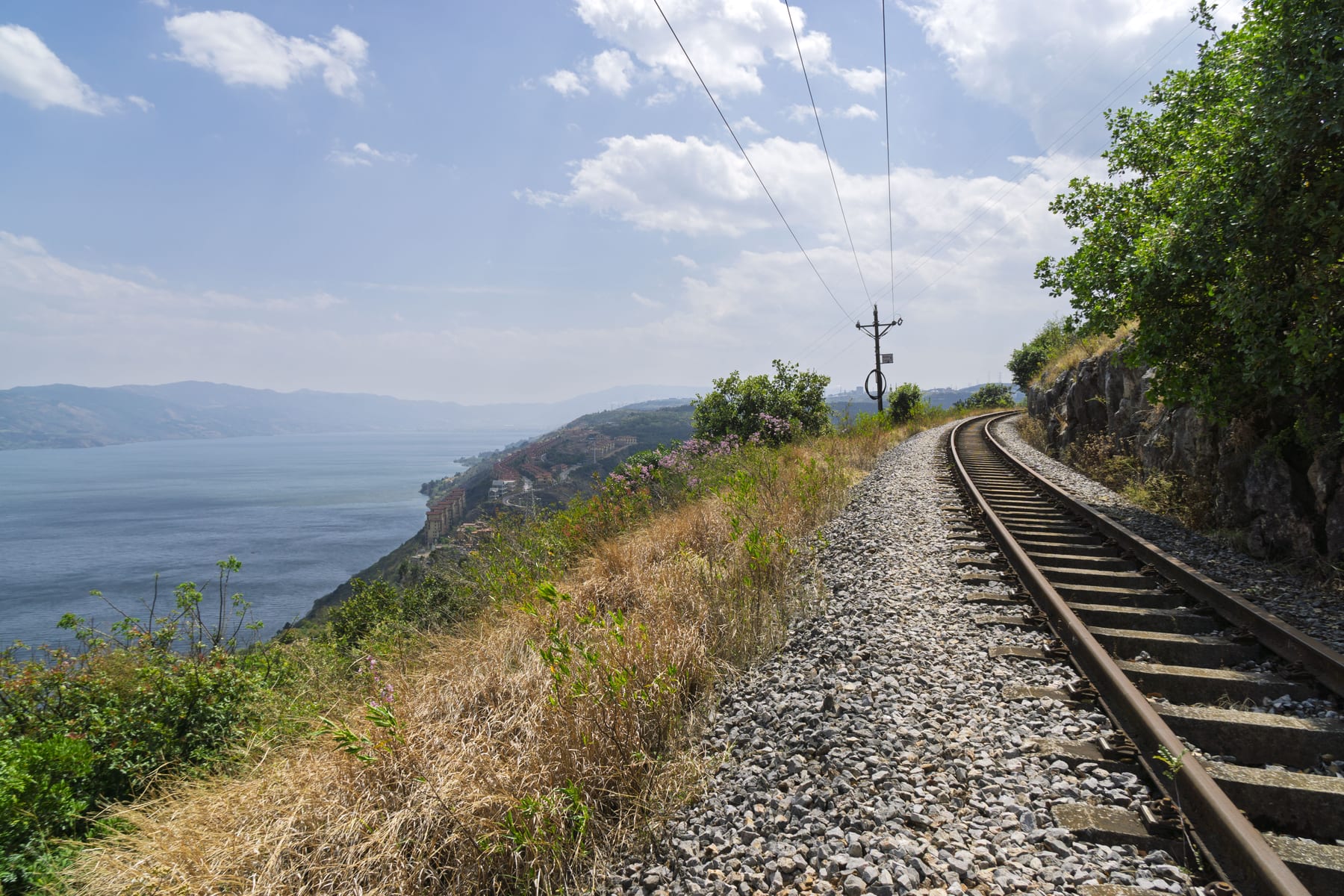
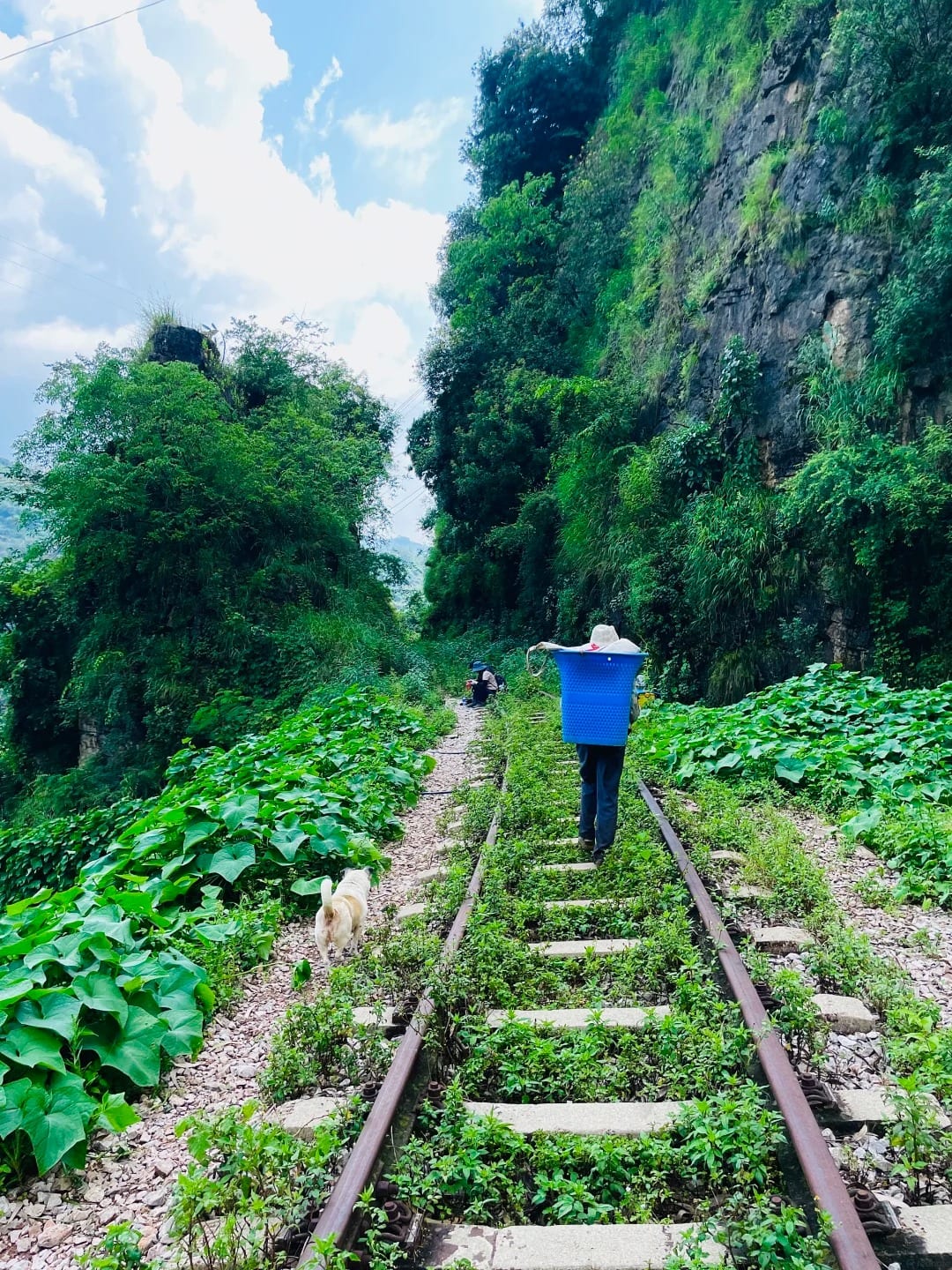
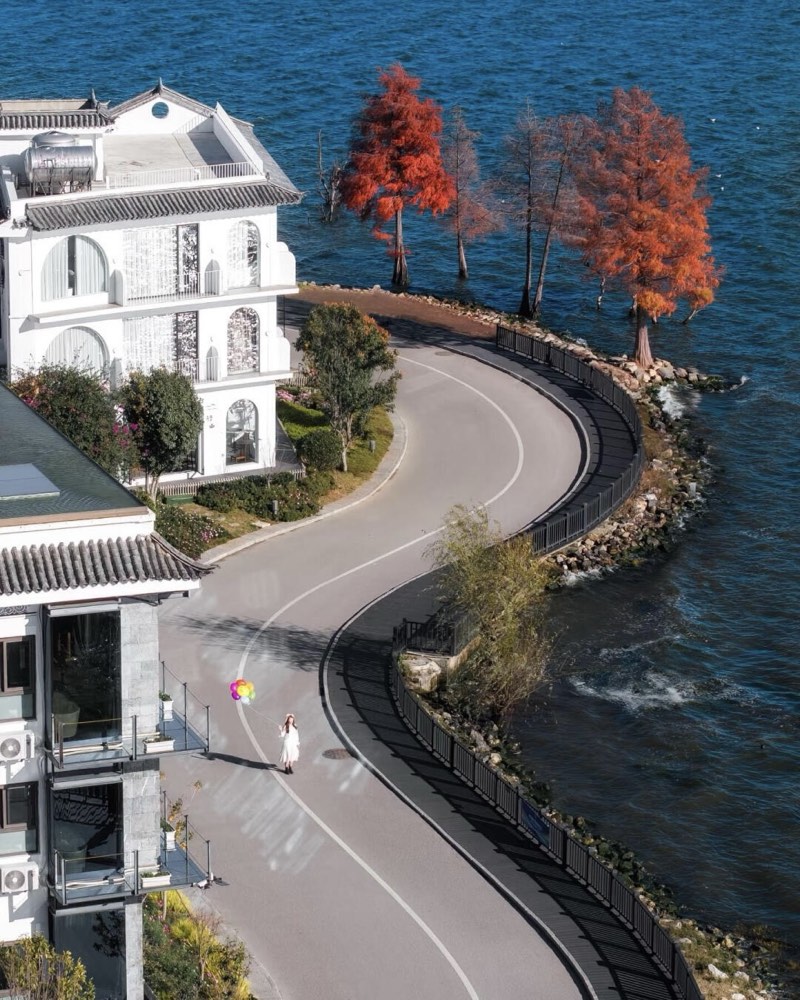
The honest history: in 2008 a smelter leaked arsenic into the lake, and drinking, swimming and fishing were banned until 2011. The water has recovered to Class II, and in 2024 the lake drew 4.81 million visits — it’s Kunming’s weekend lake. They come for the lakeside greenway, the S-bend viewpoint on the east shore, and the new Shijiazui wetland. And for railway people there’s a bonus: the 1910 Yunnan–Vietnam Railway runs right along the shore at Tangchi, on the same line as the stretch we walk.
Xingyun Lake — and the fish that won’t cross (星云湖)
Xingyun sits just south-west of Fuxian, joined to it by a 2.5-kilometre channel at Haimen. In the channel stands a rock painted with three characters: 界鱼石, the Fish-Boundary Stone. Local legend says Fuxian’s kanglang and Xingyun’s big-headed carp swim up to it and turn back, never crossing. No one has tested it. But stand there and you can see why the story stuck: Fuxian is deep and blue, Xingyun is shallow (11 metres at most), green and full of weed. Two lakes, two worlds, two and a half kilometres apart.
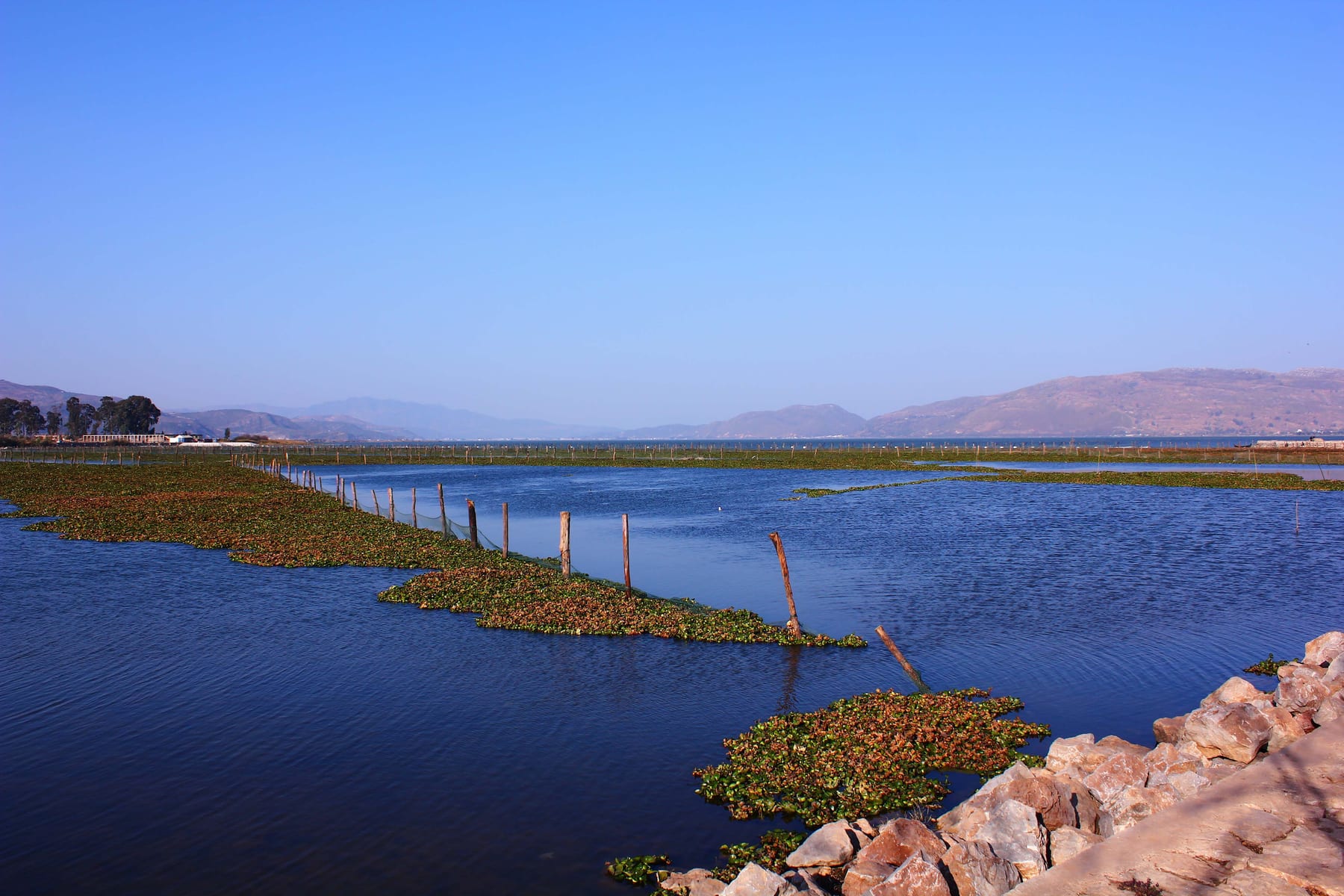
The real reason to come is underground. On the lake’s north-west corner, the Lijiashan tombs of the ancient Dian kingdom have yielded about 3,700 bronzes from 87 graves, and there’s a bronze museum in Jiangchuan. The most famous piece, the ox-and-tiger bronze table, isn’t there — it’s in the Yunnan Provincial Museum in Kunming. See it before you come.
Qilu Lake — Tonghai and Yunnan’s Mongols (杞麓湖)
Qilu is a shallow farm-country lake, under seven metres deep, with no river running out of it: the water drains away through sinkholes in the limestone. It’s not a swimming lake. It’s a lake for Tonghai, the old town on its southern shore, named a National Historical and Cultural City in 2021, with Xiushan’s temple-covered hill behind it.
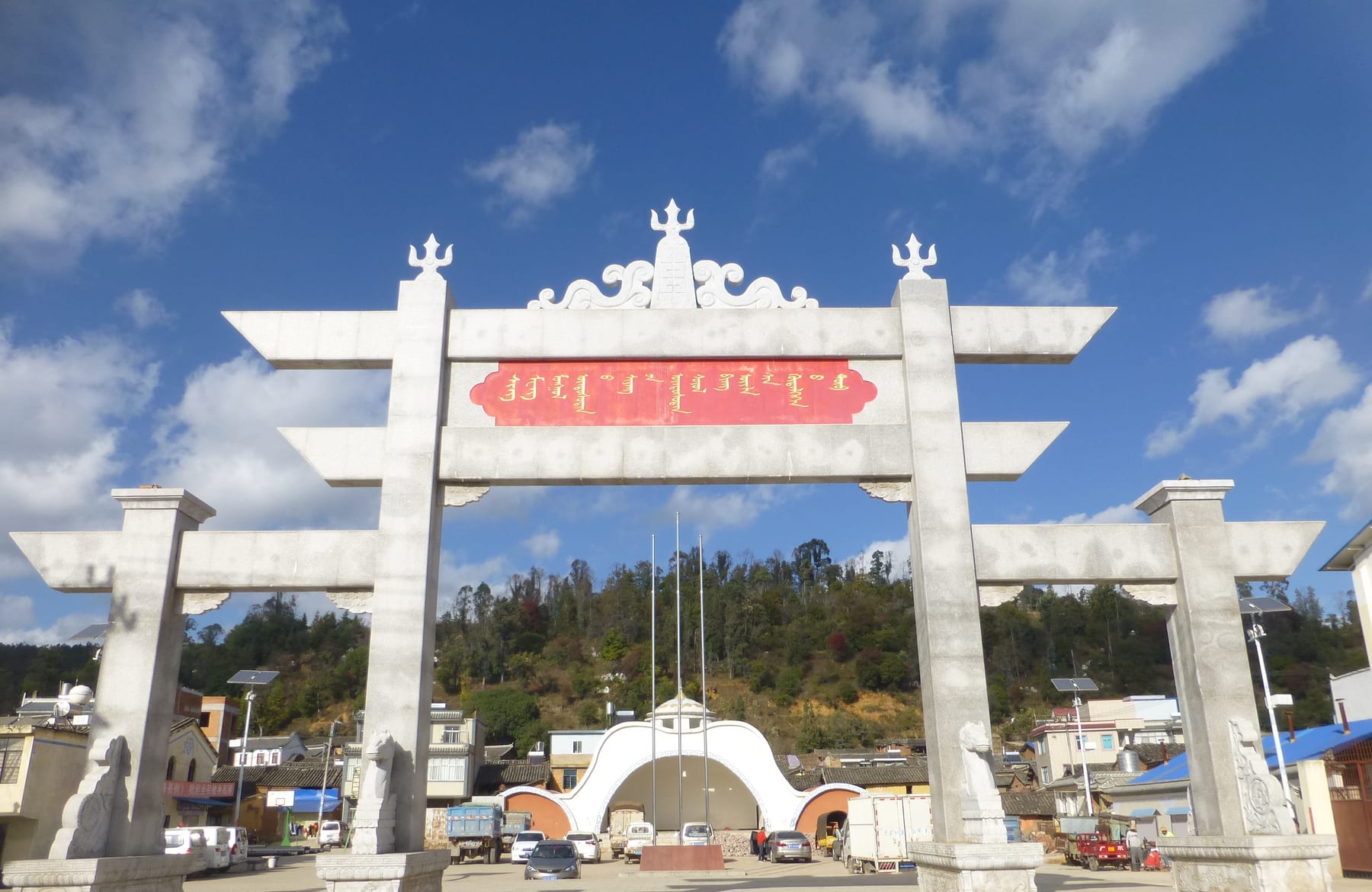
On the west shore is one of the stranger stories in Yunnan. Xingmeng (兴蒙) is a Mongol township. Its people descend from the soldiers Kublai Khan marched south in 1253 to conquer the Dali Kingdom. When the Ming took Yunnan in 1381, the survivors settled by this lake and went from herders to fishermen to farmers. Seven centuries on, they speak Khatso, a language of the Yi family rather than Mongolian. But the gateway into town is still written in Mongolian script, and their temple honours Genghis Khan. Walk or cycle the Haibin Road dike along the south shore to see the farmland and the lake together.
Yilong Lake — lotus and tofu at Shiping (异龙湖)
Yilong is the lowest and warmest of the six, at about 1,414 metres, just east of the old town of Shiping. In summer, roughly June to August, its shallows fill with lotus, planted here in 1993, and pheasant-tailed jacanas pick across the leaves. In winter the stalks die back and the black-headed gulls arrive. The water is still recovering after decades of trouble (it reached Class V only in 2025), so this is a lake to look at, not swim in.
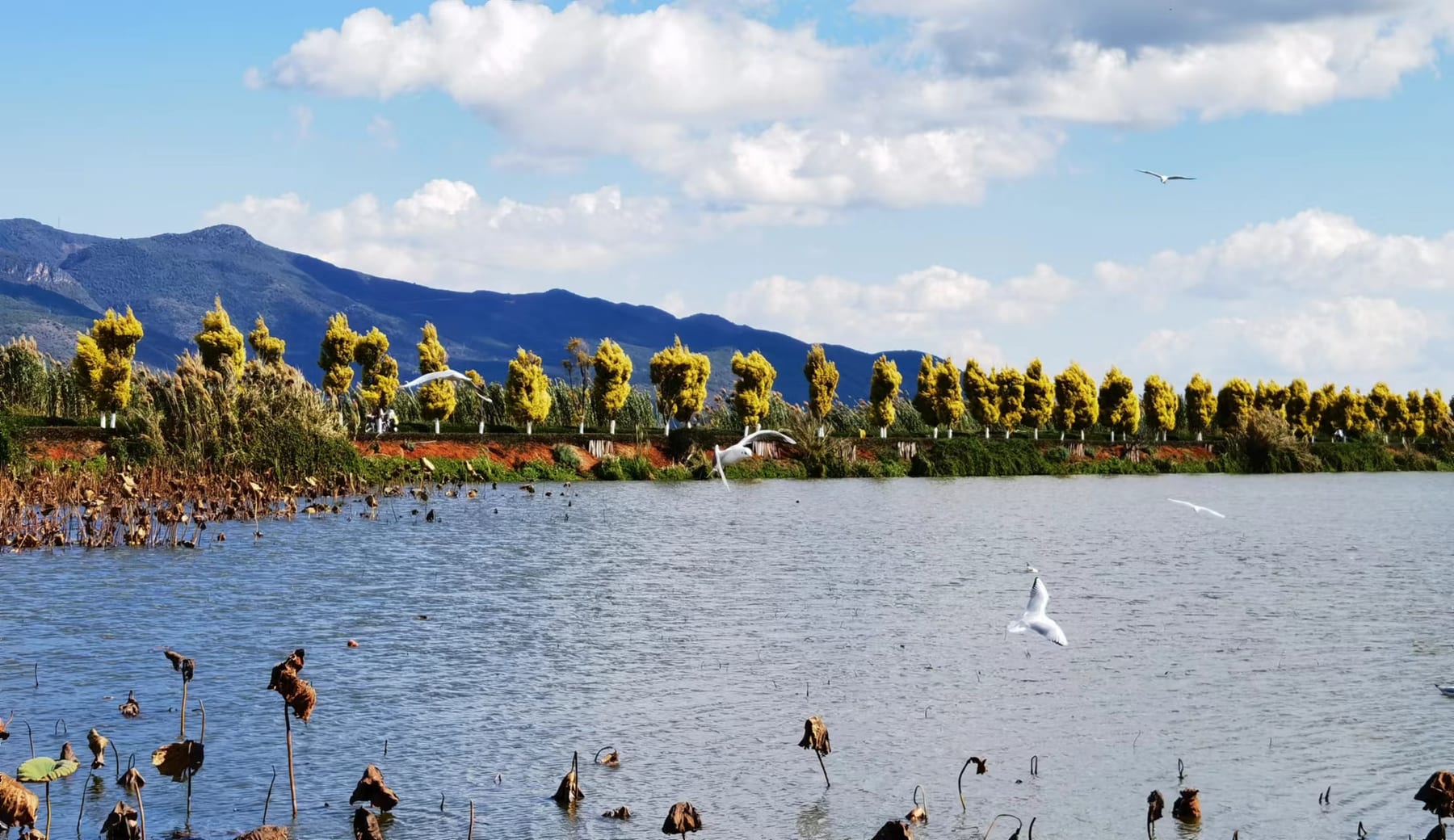
Come for the town as much as the lake. Shiping tofu is made with the sour water of the town’s old wells, then grilled at street stalls until it puffs up. You’ll taste it on day two of our Hani Rice Terraces tour with Little Chinese Everywhere. Shiping is also next door to Jianshui, where we stay at Hanlinyuan Courtyard, so the two towns pair well before you head on to the Yuanyang terraces.
Changhu — where Kunming goes camping (长湖)
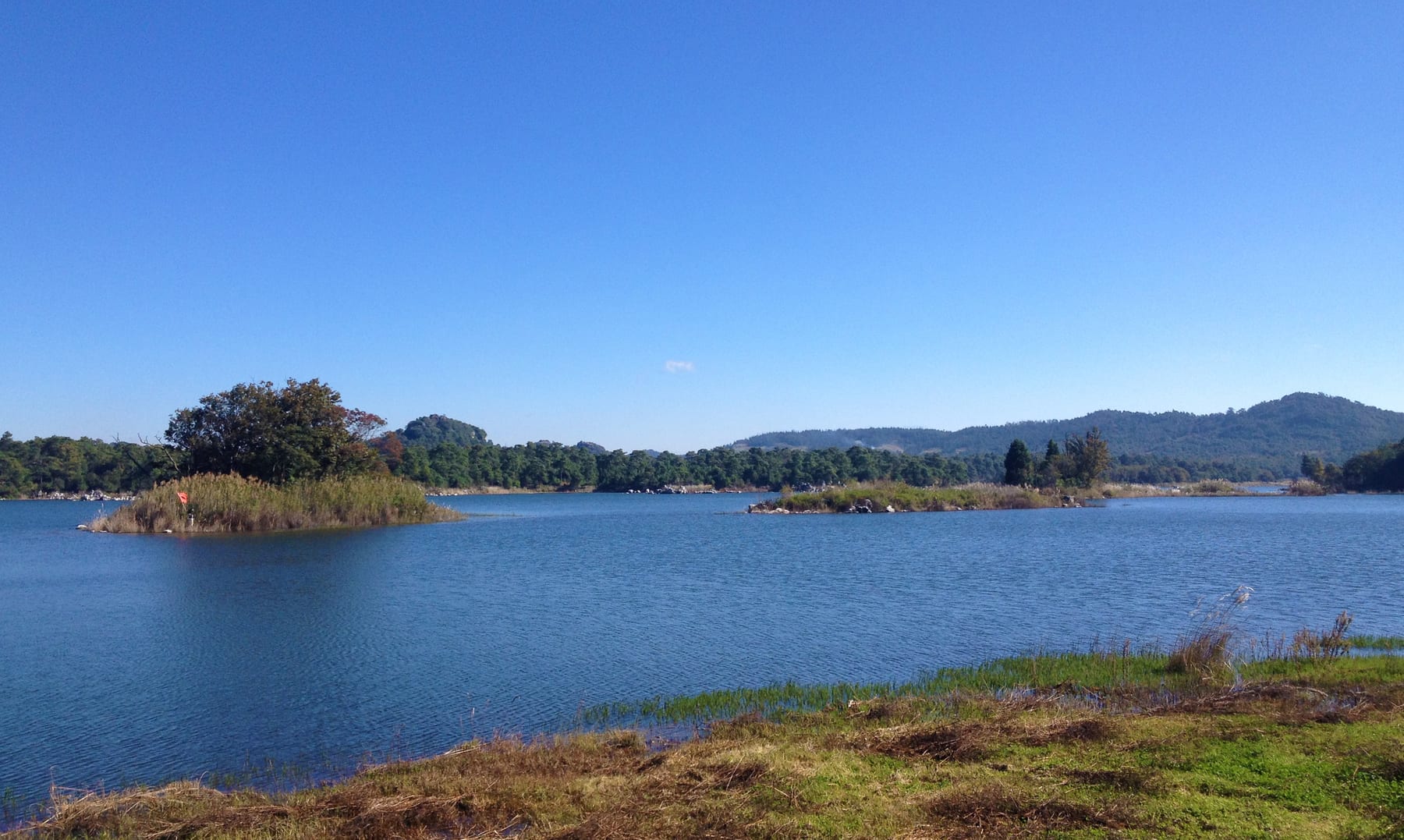
Changhu, the “Long Lake”, is tucked into pine-covered hills in Shilin county, at 1,907 metres. Locals also call it 藏湖, the Hidden Lake. It’s a karst lake fed by groundwater, about three kilometres long and up to 24 metres deep, and in Sani Yi tradition it’s Ashima’s home. It’s where Kunming families go with a tent and a barbecue: bamboo rafts, short walks, a fire by the water. At the Torch Festival, on the 24th day of the sixth lunar month, it’s one of the festival’s venues. Pair it with the Stone Forest, which sits in the same county.
And the famous ones?
Dianchi is Kunming’s own lake, the biggest in the province. It’s Class IV and better for gulls and sunsets than for the water itself — our guide to Kunming’s parks covers where to see it. Erhai belongs with a Dali trip, and Lugu with Lijiang. Chenghai, the alkaline spirulina lake, is near Lijiang too, about 265 kilometres from Kunming as the crow flies, so it’s no weekend trip.
Before you go
- Clear lakes and green lakes. Only the deep ones — Fuxian, Lugu and Yangzonghai — are properly clear. The shallow farm-country lakes (Xingyun, Qilu, Yilong) go green in summer. Go to them for the towns, the history and the food, not the water.
- Swimming. Don’t plan on it. Fuxian’s protection rules have tightened since 2024, and much of the shore is now wetland. Bring walking shoes, not a swimsuit.
- Fishing seasons. Fuxian is closed to fishing from January to June and Dianchi for part of the year, so lakeside restaurants mostly serve farmed fish. Fresh lake icefish comes in season.
- Getting around. None of these are on the tourist circuit, and signs are in Chinese only. A driver and a guide who know the back roads turn three lakes into one easy day. Here’s what a private guide actually does. Set up your China travel apps before you fly.
So which lake should you choose?
- One night by the water: Fuxian, no contest. Take the east shore for the cliffs, the west shore for the villages and sailing.
- A morning out from Kunming: Yangzonghai — the greenway, the old railway, a soak at Tangchi.
- History and small towns: Tonghai and Qilu, then Jiangchuan’s bronzes. Or Shiping and Yilong on a southern Yunnan trip.
- Summer lotus: Yilong, June to August.
- Families with a tent: Changhu.
The easiest way in is our two-day Yunnan–Vietnam Railway & Fuxian Lake small-group departure: a day on foot along the 1910 railway, a night on Fuxian’s shore, a morning on the Leidashi cliffs and stone-pot fish for lunch, any day you choose. Or tell us your dates and we’ll fit the lakes into a private trip. For the bigger picture, start with our Yunnan travel guide.
Photos via Wikimedia Commons: Luchong from the air by Chensiyuan, CC BY-SA 4.0; Fuxian Lake and Gushan by Huangdan2060, CC BY 3.0; the railway above Yangzonghai by Kcx36, CC BY-SA 4.0; Xingyun Lake by Zhangmoon618, CC BY-SA 3.0; Xingmeng gateway by Vmenkov, CC BY-SA 3.0, cropped; Yilong Lake by 鹿苑, CC BY-SA 4.0; Changhu by Zhangmoon618, CC BY-SA 4.0.